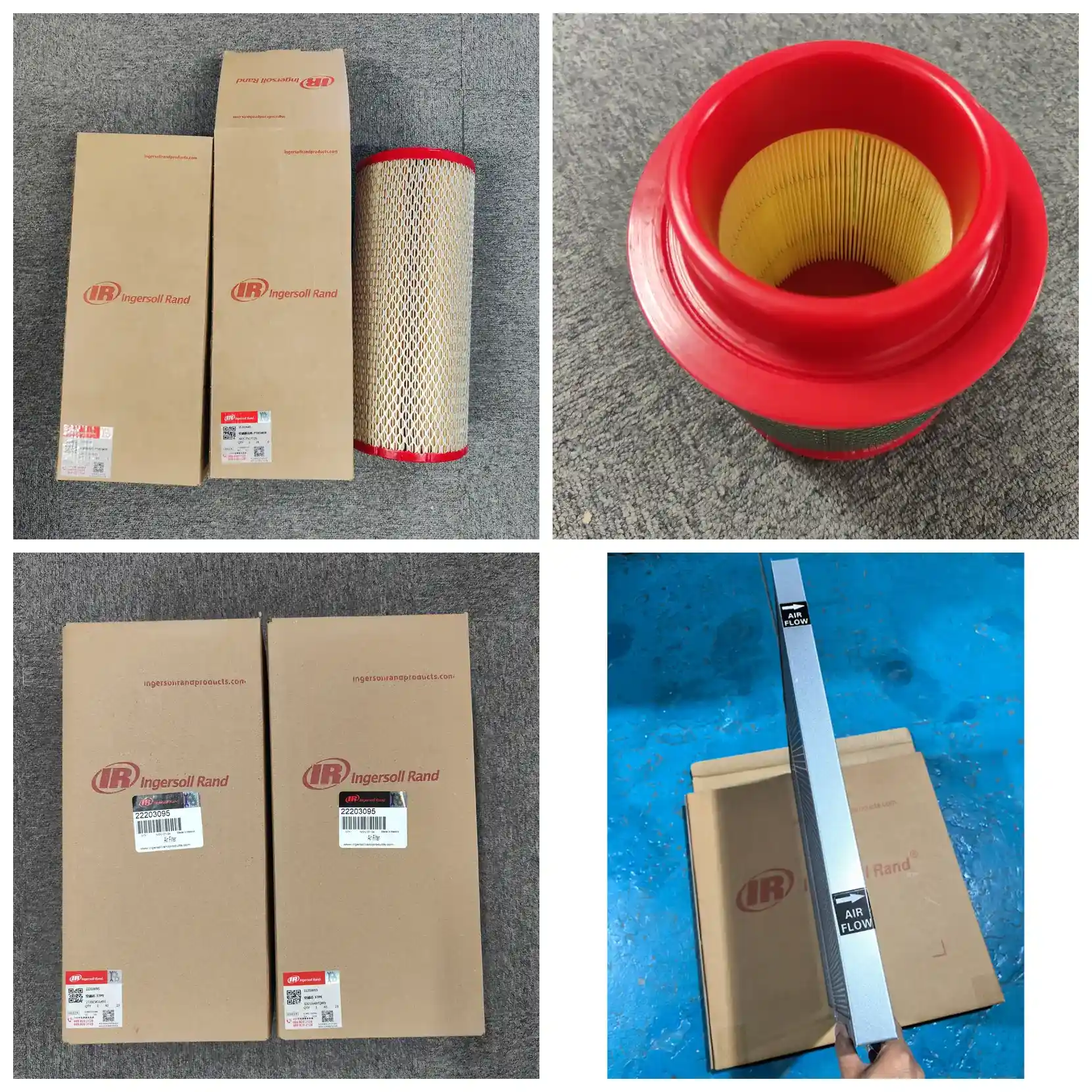
Product
Ingersoll Rand 47701889001 Air Filter Element | Replaces 39708466
Ingersoll Rand 47701889001 air filter element (previous PN 39708466) for 37–160 kW screw compressors including ML/MM/MH/MJ, XF/EP/HP/XP, SM/SL/SH and M75-2S to M160-2S. 5–10 μm filtration, ≥98% efficiency, approx. 278–280 mm OD × 127–129 mm height, 2000 h / 3-month service interval. Verify by part number before ordering.
- Export packaging & documentation support
- OEM / ODM customization available
- Sample and bulk order workflow
Product Overview
47701889001 is the intake air filter element for Ingersoll Rand screw air compressors. It replaces the previous part number 39708466, which is now marked as discontinued in the Ingersoll Rand spare parts system. Old packaging and old spare parts lists may still show 39708466 — both numbers refer to the same filter element.
The element sits inside the intake filter assembly, upstream of the airend inlet. It is the first filtration stage on the intake path, and its condition directly affects the service life of the downstream oil filter, oil separator and lubricant.
Coverage is wider than most air filters: from ML/MM/MH and MJ series 37–75 kW models, to XF/EP/HP/XP and SM/SL/SH series, and up to M75-2S to M160-2S two-stage models. One element covers five platforms and 45 models across 37–160 kW.
Core Specifications
- Part number: 47701889001
- Previous part number: 39708466
- Brand: Ingersoll Rand
- Power range covered: 37–160 kW
- Filtration rating: 5–10 μm
- Filtration efficiency: ≥98% for particles ≥5 μm
- Dimensions: approx. 278–280 mm OD, approx. 156 mm ID, approx. 127–129 mm overall height
- Recommended replacement interval: 2000 hours or 3 months, whichever comes first
Technical Parameters
Filtration Performance
- Filtration rating: 5–10 μm
- Filtration efficiency: ≥98% for particles ≥5 μm
- Filter class: Characterized by ISO 5011 efficiency, restriction and dust holding capacity — not by ventilation/AC classification (G4 / F5 / F7 etc.)
- Dust holding capacity: Depends on site dust concentration; no universal nominal value. Use intake differential pressure gauge readings as the criterion.
Filtration rating and dust holding capacity must be considered together. A high-efficiency element with limited dust space will see restriction rise quickly and require more frequent replacement, increasing total cost of ownership. This element is designed for continuous duty on 37–160 kW models, with sufficient dust space at 5–10 μm rating.
Flow and Restriction
- Rated air flow: Must not be below compressor rated intake flow; this element covers 37–160 kW models with intake flows of approx. 6–27 m³/min. Refer to compressor nameplate displacement and correct for intake temperature and altitude.
- Initial pressure drop: approx. 0.3–0.5 kPa (clean element)
- Operating differential pressure range: approx. 0.5–1.5 kPa, rising with dust accumulation
- Alarm / final restriction: Typical replacement threshold approx. 1.5–2.5 kPa; final criterion is the intake vacuum / differential pressure gauge reading
- Pressure drop vs. energy: Each 1 kPa increase in intake restriction raises the compression ratio by approx. 1%, increasing compressor energy consumption by approx. 1.0%
Pressure drop and energy consumption (theoretical, at 0.85 MPa discharge gauge pressure):
- 0 kPa (new element): compression ratio 9.39 — baseline
- 0.5 kPa: compression ratio 9.44 — +0.5%
- 1.0 kPa: compression ratio 9.49 — +1.0%
- 1.5 kPa: compression ratio 9.53 — +1.5%
- 2.0 kPa: compression ratio 9.58 — +2.0%
- 2.5 kPa: compression ratio 9.63 — +2.5%
From installation to the replacement threshold, intake restriction rises by more than 2 kPa, increasing compressor energy consumption by about 2%. ML/MM/MH and M-2S series often run continuously, so this energy difference typically exceeds the cost of the element itself. Running past the restriction limit is not economical.
Dimensions and Installation
- Outer diameter: approx. 278–280 mm
- Inner diameter: approx. 156 mm
- Overall height: approx. 127–129 mm (including end caps)
- Effective filtration area: Depends on pleat count and pleat depth; verify against the used element
- Installation interface: Cylindrical insert type, secured by end cap compression inside the intake filter assembly
- Sealing: Face seal; sealing body molded with end cap or installed separately
Recommended measurements before ordering (verify against old element):
- Outer diameter — outer edge of filter media
- Inner diameter — center passage diameter
- Overall height — including end caps
- Seal face position and type — axial / radial, and seal cross-section
- Mounting interface — clamp, bolt holes or quick-fit dimensions
Outer diameter, inner diameter, overall height and seal type determine fit and whether bypass occurs. Dimensions on this page are for initial comparison; confirm with the old element before formal purchase.
Material Construction
- Filter media: Cellulose (wood pulp) filter paper, pleated — depth filtration, retaining particles through fiber layers
- Media weight: approx. 130 g/m² — determines burst strength and dust holding space
- Inner and outer support: Galvanized steel perforated mesh — double-sided support to prevent collapse under negative pressure
- End caps: Metal or polyurethane end caps, bonded to media and acting as seal carrier
- Seal: Nitrile rubber or polyurethane seal body — prevents bypass between element and assembly
- Bonding: Polyurethane adhesive for media-to-end-cap and media-to-mesh fixing
Operating Conditions
- Operating temperature: -10 °C to +80 °C
- Relative humidity: ≤90% RH (non-condensing)
- Burst / collapse pressure: Standard design withstands differential pressure across media of at least 5 kPa without deformation
- Special function: Wide power range intake filtration; optional pre-filter layer for high-dust sites to extend main element life
For continuous operation in high-humidity, high-dust or oil-mist environments (textile, foundry, food, cement), media strength decreases when wet, and oil mist can cause surface caking. Both conditions shorten actual service life and require shorter inspection intervals.
Service Life and Maintenance
- Service life: 2000 hours or 3 months, whichever comes first
- High-dust environment: Reduce hours accordingly (e.g. approx. 1500 hours); calendar limit also shortened
- Storage life: Use within 24 months; store in dry, ventilated, dark conditions, protected from moisture and compression
- Replacement criteria: Intake differential pressure gauge exceeds limit, or media damage, debonding, or compressed seal face
Both limits apply: 2000 hours or 3 months, whichever comes first. The calendar limit exists because media absorbs moisture and ages over time — even if operating hours are not reached, compressors on standby or intermittent duty still need periodic replacement.
Standards
- ISO 5011: Intake filter efficiency and dust holding capacity test method — basis for performance characterization of this type of air filter element
- GB/T 14295: National air filter standard, often referenced for domestic procurement and acceptance
- ISO 8573-1: Compressed air quality classes, used to describe complete compressor supply air quality
- Note: ISO 2941 / 2942 / 2943 / 3723 / 3724 series are hydraulic filter standards; ISO 16889 multi-pass method is also for liquid filtration; EN 779 and its G4–F9 classes are for ventilation and air conditioning filters. None of these apply to compressor intake air filter elements and should not be used as performance criteria for air filters.
Installation and Maintenance Steps
- Confirm compressor status and spare parts. Check compressor nameplate model and power. Confirm the new element matches the old part number (if the old element is marked 39708466, it is the same part). Prepare new element, clean cloth and necessary tools.
- Stop, depressurize, disconnect power. Follow shutdown procedure and wait for complete depressurization. Disconnect main power and apply lockout/tagout. This step is mandatory.
- Verify old element before starting work. Before opening the intake filter assembly, read the part number stamped on the old element end cap and note its position. This element covers five platforms and 45 models across 37–160 kW; some platforms have both main and safety filters. This step prevents errors.
- Remove old element and inspect. Lift out the old element vertically and check dust distribution and media condition. Replace immediately if media is damaged, perforated, end cap debonded or seal face compressed — even if the service interval has not been reached. Black oily sludge on the surface indicates abnormal oil mist in intake air; check upstream environment.
- Clean assembly interior. Wipe inner walls and bottom with a lint-free cloth. Do not blow compressed air into the assembly — it will drive dust into the intake path. Criterion: no loose dust on inner walls, seal face flat and free of debris.
- Install new element. Install in the same orientation and position as the old element, paying attention to seal face direction and compression. Criterion: element sits without movement, seal face evenly compressed around circumference.
- Reassemble and confirm seal. Refit cover or clamp and tighten evenly as specified. Check intake vacuum gauge impulse line for blockage — a blocked line gives a false clean reading, a common source of misjudgment.
- Test run and record. Reset maintenance timer, start compressor unloaded and observe intake vacuum gauge reading and running sound. Criterion: vacuum gauge stable within allowed range, no abnormal whistling (whistling often indicates seal bypass). Record operating hours at replacement as the start of the next interval.
FAQ
Q1: Is 47701889001 the same part as 39708466?
Yes. 39708466 is the previous OEM part number for this item. Ingersoll Rand migrated a batch of M series air filters from old numbers to new 11-digit numbers; 39708466 corresponds to 47701889001. The old number is marked discontinued in the current spare parts system. Old drawings and spare parts lists may show 39708466 — both numbers refer to the same element.
Q2: Can 47701889001 be interchanged with 47701890001 or 47701891001?
No. All three are from the same migration batch and share the same name (air filter element), but they serve different power ranges. This element covers 37–160 kW M series and SM/SL/SH platforms; the other two are for higher power models. Always verify by the part number stamped on the old element — do not order based on similar names.
Q3: Which models does this element fit?
Coverage is wider than most air filters. See the model list in the next section, grouped by platform. Typical models include ML/MM/MH 37–75, XF/EP/HP/XP 50–100, SM/SL/SH series, and M75-2S to M160-2S two-stage models. If unsure, provide the compressor nameplate model and a photo of the old element; we will cross-check by part number.
Q4: Why can one element cover such a wide power range?
Fit depends on the intake assembly interface and compressor restriction at rated intake flow, not on power alone. The intake assembly interface of this platform is common across 45 models from 37–160 kW, so the same element is used across three power bands. Higher power models may use multiple elements per compressor; confirm quantity per machine before ordering.
Q5: What are the dimensions?
Outer diameter approx. 278–280 mm, inner diameter approx. 156 mm, overall height approx. 127–129 mm, net weight approx. 1.25 kg. Dimensions vary slightly by production batch and media configuration. Before formal purchase, measure the old element or provide photos and compressor nameplate for cross-check by part number.
Q6: What is the replacement interval?
Standard interval is 2000 hours or 3 months, whichever comes first. In high-dust environments (cement, quarry, mining, metalworking), reduce hours to approx. 1500. Final criterion is the intake differential pressure gauge reading — replace when the reading exceeds the limit, regardless of operating hours.
Q7: What happens when intake restriction rises?
First, energy consumption increases: each 1 kPa increase in intake restriction raises compression ratio by approx. 1%, increasing compressor energy consumption by approx. 1%. Second, intake flow decreases, reducing compressor discharge flow. Running past the replacement threshold costs more in electricity than the filter element saves. This is especially noticeable on continuously running compressors.
Q8: Can I use an alternative element?
Yes, but verify three points: filtration rating, end cap seal type, and dimensions. If the seal type does not match the original, bypass can occur and unfiltered air enters the airend, accelerating rotor and bearing wear. When purchasing alternatives, provide a photo of the old element and this part number.
Q9: What if there is abnormal whistling after installation?
Whistling usually indicates seal bypass — element not fully seated, seal face deformed, or seal missing. Stop the compressor immediately and check: element seating, seal face compression or inversion. Also check the intake vacuum gauge impulse line for blockage to avoid misjudgment.
Q10: How do I replace on two-stage intake systems?
If the intake assembly has two stages (main filter + safety filter), the two elements have different part numbers and positions and are not interchangeable. Replace in order from outside to inside, and verify each element against the ordered part number. The safety element acts as a backup if the main filter fails; do not leave it unchanged just because it looks clean.
Q11: What are the storage requirements?
Store in a dry, ventilated, dark place, protected from moisture, rain and heavy compression. Moisture reduces media strength; compression deforms the seal fit. Use within 24 months.
Compatible Models
This element covers five Ingersoll Rand screw compressor platforms, 45 models across 37–160 kW, grouped by platform and power range below.
- ML / MM / MH / MJ series (37–75 kW): ML37, MM37, MH37, ML45, MM45, MH45, ML55, MM55, MH55, MJ55, ML75, MM75, MH75, MJ75
- XF / EP / HP / XP series (50–100 kW): XFE50, EPE50, HPE50, XF60, EP60, HP60, XF75, EP75, HP75, XP75, XF100, EP100, HP100, XP100
- SM / SL / SH series (50 Hz, 37–75 kW): SM37, SL37, SM45, SL45, SH55, SH75
- L / H / HH series (60 Hz, 50–100 kW): L50, L60, H50, H60, HH75, HH100
- M series two-stage compressors (75–160 kW): M75-2S, M90-2S, M110-2S, M132-2S, M160-2S
Adjacent platforms for reference (different part numbers — not interchangeable):
- ML/MM/MH/MU 90–160 (90–160 kW): 39903291 — higher power platform, different part number
- 125S / 150S / 175S / 200S, M350-3S (90–160 kW): 39903281 — higher power platform, different part number
- M250 / ML250 (approx. 40 m³/min): 39903265 / 42852129 — larger platform, not interchangeable with this element
- Same migration batch: 47701890001, 47701891001 — same name, different power band, not interchangeable
Why verify by part number, not by compressor model: This element covers five platforms and a wide 37–160 kW range. Within the same power band there may be different production batches and intake assembly configurations. Selection should be based first on the part number stamped on the old element, second on the compressor nameplate model, and third on installation position.
Three-step verification:
- Read the part number stamped on the old element end cap or mesh and compare with this part number or the previous number (previous number is the same part; see Technical Parameters).
- Read the compressor nameplate model and confirm it is in the model list above.
- Confirm the old element installation position (single-stage / two-stage, main / safety) and quantity per machine.
If the three steps still do not confirm, provide compressor nameplate photo, old element photo (including stamped part number) and installation position description. We will cross-check by part number.
Related Parts
Parts commonly maintained on the same models and intervals:
- Oil filter element — 39911631: Removes wear particles and sludge from lubricant, protecting rotor and bearings. Check together with air filter; replace per compressor manual.
- Oil filter assembly — 39259668: Housing assembly for oil filter element. Check seal face and mounting base for leaks.
- Oil separator element — 54601513: Separates oil mist from compressed air and returns oil, controlling oil carryover. Check oil return line for blockage at replacement.
- Lubricant (Ultra Coolant) — 38459582: Standard Ingersoll Rand screw compressor coolant for lubrication and sealing. Test per compressor requirements; avoid mixing with other brands.
- Air filter housing — 39911458: Housing assembly that holds and secures the intake element. Check clamps, seal face and outlet end for deformation or corrosion.
- Air filter housing cover — 39911359: Closes intake housing and compresses element end face. Check seal face flatness and fasteners.
- Safety filter element (two-stage intake): Backup if main filter fails, preventing unfiltered air from entering airend. Check together with main filter; do not leave unchanged just because it looks clean.
- Intake differential pressure / vacuum gauge: Shows intake restriction and is the final criterion for replacement interval. Check impulse line regularly for blockage — blockage gives a false clean reading.
Recommended replacement combination: Air filter, oil filter and oil separator share the 2000-hour interval. Replace together to avoid maintenance interval mismatch. For high-dust sites, install a pre-filter layer — pre-filter cost is far lower than the main element and replacement is faster.
For specific part numbers: Items marked with "—" above should be confirmed against the compressor parts manual. This element covers five platforms; related part numbers must match the specific model and should not be applied across platforms.